A 1.6 per cent rally priced hope, not a decision
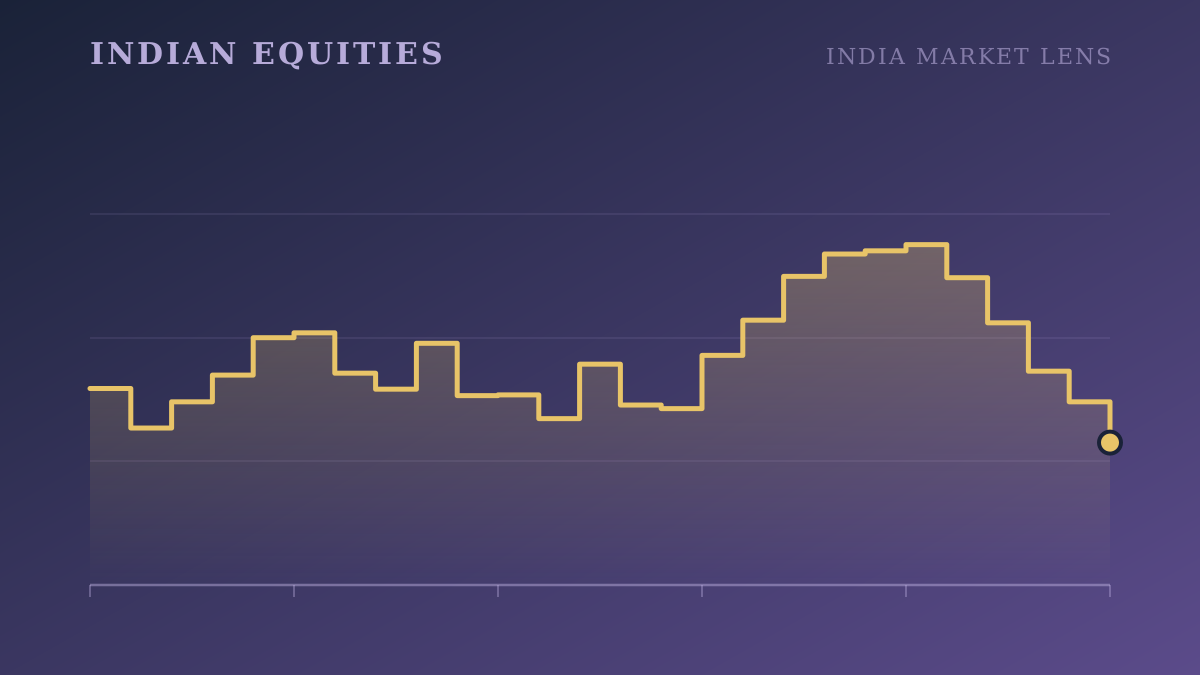
The Nifty 50 rose 358.60 points, or 1.60 per cent, on 13 October after Finance Minister Nirmala Sitharaman said debate over long-term capital-gains tax and securities transaction tax was healthy and that she was keen to hear investors’ views. The Sensex added 1,109.10 points, or 1.54 per cent. Both indices extended their gains after her comments during market hours.
Sitharaman did not promise a reduction or abolition. Listed shares and equity-oriented funds remain subject to LTCG tax of 12.5 per cent on annual qualifying gains above ₹1.25 lakh, provided the assets have been held for more than 12 months and the relevant STT conditions are met.
The market priced a possibility, not a policy. The timing supports the view that Sitharaman’s remarks contributed to the rally, but it does not establish that they caused the entire move. Technology shares rebounded sharply and bargain buying also helped. Investors should therefore treat the advance as evidence of sensitivity to tax policy, not as a reliable estimate of the value of a future tax cut.
A lower LTCG rate can support patient capital, but only if the holding-period rules distinguish investment from trading and the fiscal cost is measured openly.
Foreign selling is the warning, but tax is not the whole explanation
Foreign portfolio investors withdrew ₹3.08 lakh crore from Indian equities during 2026 through 12 October, according to NSDL data reported by Business Standard. That was nearly twice the ₹1.66 lakh crore withdrawn during all of 2025. Selling reached ₹35,861 crore in September and ₹47,417 crore through 12 October.
Yet foreign investors remained active where companies raised fresh capital. They put ₹56,485 crore into the primary market during 2026 through 12 October while withdrawing ₹3.64 lakh crore from the secondary market. Capital is the lifeline of business, but these figures suggest that price, currency risk and the availability of attractive new issuance matter alongside taxation. Tax relief alone cannot reverse a global portfolio reallocation.
The outflows strengthen the case for reviewing the total cost of investing in India, but they do not prove that LTCG tax caused the selling. Dollar strength, oil prices, US bond yields, relative valuations and North Asia’s technology rally have also influenced allocation. The continued FPI demand for new issues further complicates the claim that foreign capital has rejected India wholesale.
A well-designed cut could align three interests
Investors would keep more of a realised long-term gain. That raises the after-tax return from holding productive assets and reduces the penalty attached to switching from an overvalued company to one with better prospects. A more stable regime would matter as much as the headline rate because investors price the risk of repeated tax changes.
Businesses could benefit through a deeper pool of patient equity. Greater willingness to commit capital for several years can support secondary-market liquidity, new issuance and corporate investment. Lower financing friction is particularly valuable when foreign investors are retreating and domestic institutions are carrying more of the market.
The government’s potential gain is indirect. Deeper markets can broaden ownership, improve access to equity finance and support future taxable profits. The state could also collect more from a larger base of transactions and income. None of those effects is guaranteed, however, and they should not be presented as a free fiscal dividend.
The triple win is plausible, not automatic. Investors receive the direct benefit. Companies gain only if tax relief changes portfolio allocation or holding periods. The government benefits only if greater activity, investment and taxable income compensate sufficiently for the lower rate. A cut that merely rewards gains already accrued would transfer revenue without materially improving capital formation.
The opposing case starts with revenue and ends with volatility
The case against a reduction is substantial. LTCG tax falls on realised gains and therefore captures part of the return generated by rising asset values. Cutting it would initially reduce the tax due on each affected rupee of gains. The benefit would also be concentrated among investors with gains above the ₹1.25 lakh annual exemption, while taxpayers without financial assets would receive nothing directly.
Preferential taxation can distort behaviour. Investors may hold weak assets until they cross the qualifying date, sell immediately afterwards or restructure short-term strategies to obtain long-term treatment. If relief attracts fast-moving capital rather than committed funding, turnover and valuation swings could rise instead of fall. Combining a lower LTCG rate with reductions in STT would magnify the immediate revenue risk.
There is also a credibility cost. The equity LTCG rate was raised to 12.5 per cent in July 2024 and left unchanged in the 2026 Budget. Another alteration would help only if it made the regime more durable, not less.
This objection is strongest when a tax cut is detached from a longer holding requirement. India already classifies listed equity held for more than 12 months as long term. That boundary is short enough for portfolio turnover to receive preferential treatment. Reducing the rate while leaving that definition untouched could weaken the distinction between investment and trading.
The design must reward duration, not merely reduce tax
SBI Research has proposed removing equity LTCG tax while extending the qualifying holding period to two or three years. The principle is defensible even if abolition is fiscally too costly. Relief could be tied to longer ownership, with the existing treatment retained for positions sold earlier. That would make duration, rather than asset ownership alone, the basis of the concession.
STT and LTCG should be considered together because investors bear both, but they perform different functions. STT is collected on transactions and is comparatively difficult to avoid. LTCG tax targets profitable disposals. Removing both without replacement would sacrifice revenue while making rapid turnover cheaper. Maintaining a transaction levy while granting measured relief to genuinely long holdings would better balance collection and capital formation.
The October rally shows that tax stability has value. The deciding test is whether the next Budget can lower the burden on patient capital without turning a long-term concession into a subsidy for short-term speculation.
The sound case is therefore for conditional relief rather than abolition. A lower rate should reward demonstrably patient ownership, not every position that survives the current 12-month line. It should also be evaluated against actual holding periods, FPI flows, primary-market fund-raising, volatility and revenue collected, rather than against a single market rally.
Sources
- https://www.incometaxindia.gov.in/w/%E2%80%8B%E2%80%8B%E2%80%8B%E2%80%8B%E2%80%8B%E2%80%8B%E2%80%8B%E2%80%8B%E2%80%8B%E2%80%8B%E2%80%8B%E2%80%8Bspecial-provision-for-sale-of-shares%E2%80%8B
- https://www.incometaxindia.gov.in/w/tax-on-long-term-capital-gains%E2%80%8B
- https://indianexpress.com/article/business/ltcg-tax-debate-nirmala-sitharaman-market-rally-10920113/
- https://indianexpress.com/article/business/sensex-rally-ltcg-tax-relief-hopes-nifty-it-stocks-10920464/
- https://www.business-standard.com/markets/news/record-fpi-outflows-top-3-trillion-in-cy26-nearly-double-2025-tally-126101300072_1.html
- https://www.thehindubusinessline.com/markets/fpis-pull-out-44166-cr-from-equities-so-far-in-oct-2026-outflows-cross-3-lakh-cr/article71570941.ece
- https://www.business-standard.com/markets/news/fpis-keep-ipo-faith-amid-stock-selloff-for-3rd-year-running-will-trend-last-126101400110_1.html
- https://www.moneycontrol.com/news/business/personal-finance/fm-open-to-ltcg-tax-review-what-experts-are-saying-14052148.html/amp